
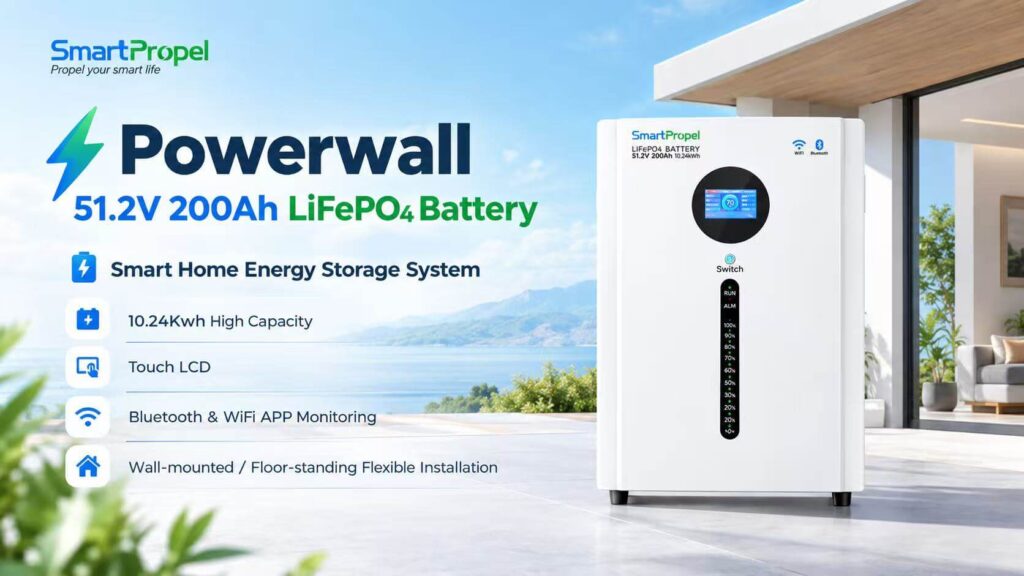
Why is a 48V 300Ah LiFePO4 battery called 15kWh? Learn the simple math — 300Ah × 51.2V = 15.36kWh — and why nominal voltage decides the number.
Buy a lithium storage battery and you’ll quickly meet two ratings that seem to describe the same thing: 300Ah and 15kWh. Do the math at a flat 48V and you get 300 × 48 = 14.4kWh — so where does “15kWh” actually come from? The answer is one small but crucial detail: what “48V” really means on a LiFePO4 battery. This guide explains the difference in plain language, so you can read any spec sheet with confidence.
Ah vs Wh: Two Different Units
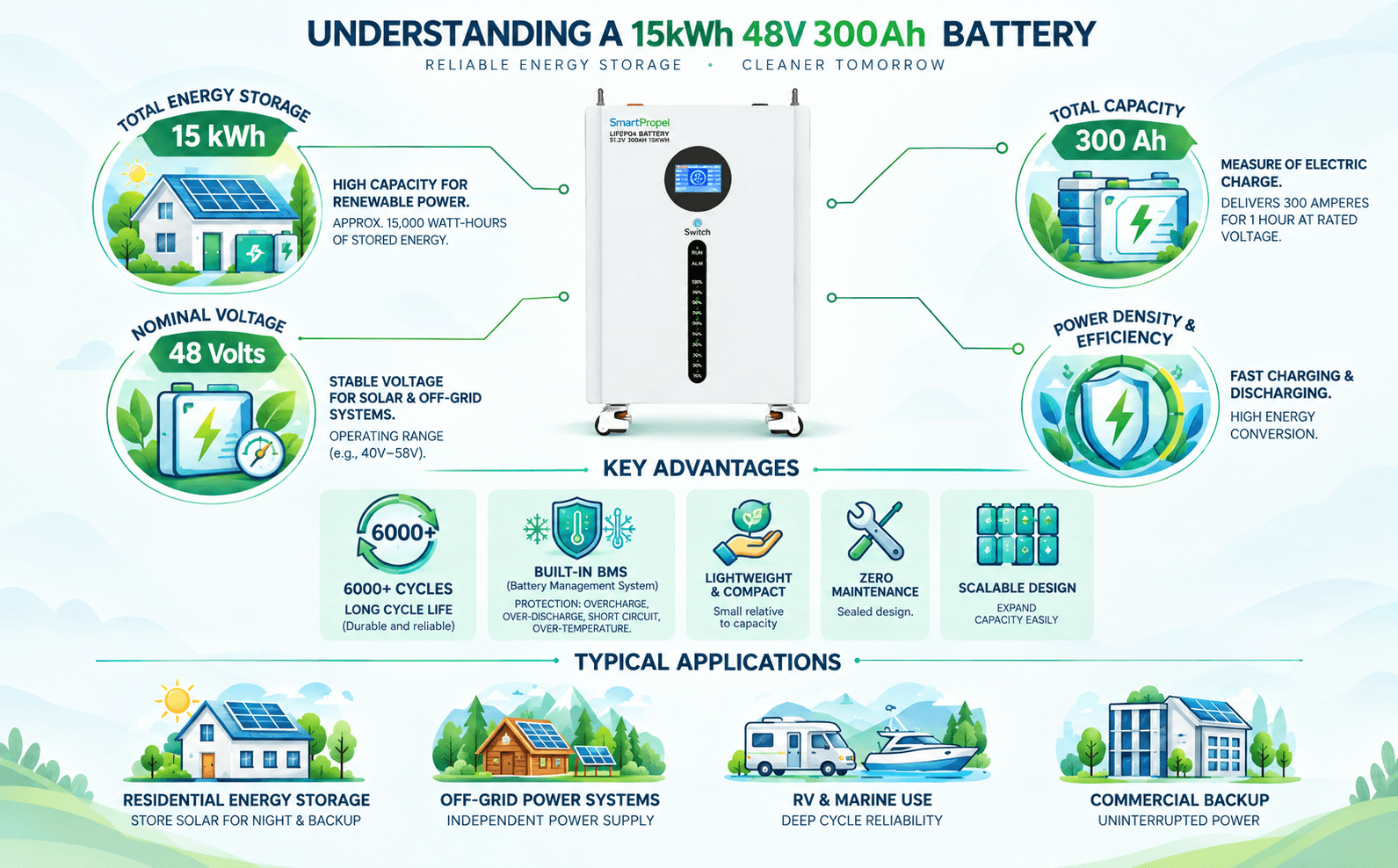
Ampere-hours (Ah) measure current over time — they tell you how much charge a battery can hold, like the size of a fuel tank. Watt-hours (Wh) measure energy — how much work that charge can do, which is what actually powers your appliances.
The two are linked by one variable: voltage.
Wh = Ah × V:That single formula lets you convert between Ah and Wh whenever you know the battery pack’s nominal voltage.
The Math Behind “15kWh”
Take a 300Ah battery labelled as a 48V system:
At a flat 48.0V: 300Ah × 48V = 14,400Wh = 14.4kWh.
That is the mathematically strict figure for 48V. So why do so many suppliers call the same battery “15kWh”? Because a “48V” LiFePO4 battery is not actually 48.0V.
The “48V” Nominal-Voltage Trap
Most so-called 48V lithium battery packs are built from LiFePO4 cells with a nominal voltage of 3.2V. A standard 48V-class pack connects 16 cells in series: 16 × 3.2V = 51.2V. That 51.2V is the pack’s real nominal voltage.
Now recalculate the same 300Ah pack at its true nominal voltage: 300Ah × 51.2V = 15,360Wh ≈ 15.36kWh, usually rounded to 15kWh for simplicity.
(For reference: hitting exactly 15.0kWh at a flat 48V would require 15,000 ÷ 48 = 312.5Ah.) So “15kWh” is not a rounded-up exaggeration — it is the honest energy figure at the pack’s real operating voltage. Both numbers are true; they just use different reference voltages.
| Nominal voltage | Capacity | Energy |
| 48.0V | 300Ah | 14.4kWh |
| 51.2V (16S LiFePO4) | 300Ah | 15.36kWh (≈ 15kWh) |
| 48.0V | 312.5Ah | 15.0kWh |
Why This Matters in the Real World
-
Sizing inverters and solar panels. Loads are rated in watts and energy in Wh/kWh, so you must compare batteries by energy, not by Ah alone.
-
Comparing competing batteries. Convert everything to the same nominal voltage — or check which voltage the manufacturer used for its kWh figure — before deciding.
-
Managing expectations. The gap between 14.4kWh and 15kWh is pure rounding + nominal-voltage definition. In the right context, neither number is misleading.
How to Verify Any Battery’s Rating
Whenever a spec sheet quotes kWh, ask two questions: what is the Ah, and what nominal voltage was used? Multiply them yourself with Wh = Ah × V — it takes ten seconds and removes all guesswork. If you’re still unsure how energy ratings translate into real runtime, our guide on how long a 10kWh battery can power a house walks through the practical side.
What the SmartPropel 51.2V 300Ah Model Delivers
Our 48V/51.2V LiFePO4 home energy storage battery is a good example of this in practice: the 300Ah model is built as a 16S1P pack with a real nominal voltage of 51.2V, giving 15.36kWh of energy — the “15kWh” figure on the label. It comes in the same floor-standing family as our 5kWh and 10kWh models, so you can compare all three capacities side by side. Pairing it with the right inverter? See our inverter power matching guide.
Every unit in the series combines tightly matched LiFePO4 cells with a built-in 100A/200A BMS and circuit breaker, 15-unit parallel support, RS485/CAN communication and a 15-year design life — verified by CE, UN38.3, FCC, UL and RoHS testing.
Q1. Is my 15kWh battery actually 14.4kWh?
No — it’s genuinely 15.36kWh at its real nominal voltage of 51.2V. The 14.4kWh figure only appears if you (incorrectly) assume a flat 48.0V for a LiFePO4 pack.
Q2. Which voltage should I use for sizing my system?
Use the pack’s real nominal voltage (51.2V for 16S LiFePO4) and its kWh rating. Inverter specs will match this nominal voltage class.
Q3. Why do different brands quote different kWh for the same 300Ah?
They may use different nominal voltages (48.0V vs 51.2V vs 51.8V for newer cells) in their marketing. Always ask which voltage the kWh number is based on.
Q4. Does this change how much I can actually power?
The useful energy is what matters. 15.36kWh at 90% usable depth of discharge gives roughly 13.8kWh of usable energy — enough context to size loads realistically.
“15kWh on a 48V battery” isn’t a contradiction — it’s the result of a LiFePO4 pack’s true 51.2V nominal voltage. Keep the formula Wh = Ah × V in mind, always check the reference voltage behind any kWh claim, and you’ll never be confused by spec sheets again.Want to see the 300Ah / 15.36kWh model — or compare it with the 5kWh and 10kWh versions? View the full 48V/51.2V LiFePO4 home battery series or contact our team for a free sizing consultation.