
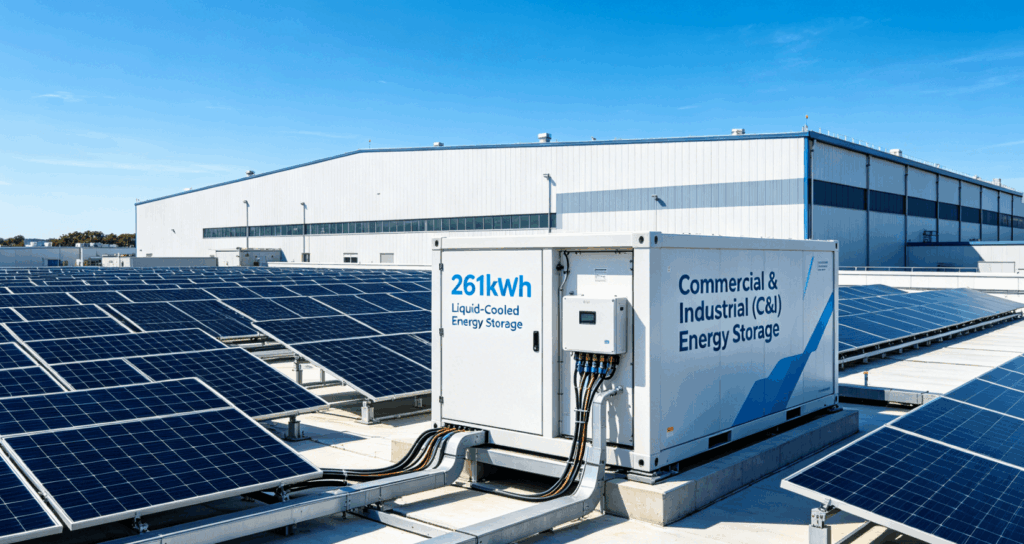
In recent years, residential energy storage has dominated overseas export markets. However, a newly released research report from CITIC Construction Investment — Overseas User-Side Energy Storage Booms: Industrial & Commercial Storage Decides Market Competition — delivers a core industry judgment:
Industrial and commercial (C&I) energy storage will become the second major growth driver for energy storage manufacturers in the next 3 to 5 years. Judging market prosperity merely by unit shipment volume severely underestimates real market growth potential. In terms of long-term market ceiling, annual new installed capacity, single-project revenue scale and profit elasticity, C&I energy storage outperforms residential storage comprehensively. The global overseas C&I energy storage market has officially entered an explosive growth window.
Based on full data from the research report, this article analyzes opportunities for C&I energy storage from six dimensions: market scale, product iteration, growth logic, regional global demand, industry barriers and standardized system solutions.
Market Forecast: C&I Storage Has Far Larger Long-Term Ceiling with Massive Room for Penetration Growth
CITIC Construction Investment built the world’s first demand calculation model covering both residential and C&I energy storage, quantified by global industrial and residential power consumption data. Key figures clearly show the gap between the two tracks:
Long-term cumulative installed capacity comparison
Total long-term demand for C&I energy storage: 4,592 GWh, corresponding to an overall market size of around 4.7 trillion RMB
Total long-term demand for residential energy storage: 2,842 GWh, corresponding to an overall market size of around 4.6 trillion RMB. The core logic is straightforward: total global industrial and commercial power consumption far exceeds household electricity demand. Factories, industrial parks, data centers, mining zones and commercial complexes generate steady continuous storage demand, creating a larger long-term incremental gap.
Extremely low current penetration with huge upside
By the end of 2025, the global penetration rate of residential energy storage reached approximately 3%, while C&I energy storage penetration stood at only 0.9%. The vast majority of overseas factories have not yet deployed energy storage, meaning the industry remains in the early growth stage with abundant room for expansion.
Forecast of new installed capacity & year-on-year growth (2026–2027)
| Storage Category | New Installed Capacity 2026 | Year-on-Year Growth 2026 | New Installed Capacity 2027 | Year-on-Year Growth 2027 |
| Residential Energy Storage | 45 GWh | 56% | 58 GWh | 28% |
| Commercial & Industrial (C&I) Energy Storage | 16 GWh | 82% | 26 GWh | 63% |
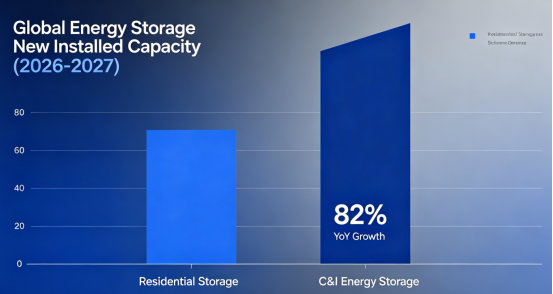
The data clearly demonstrates that C&I storage maintains ultra-high growth of 80% and 63% for two consecutive years, significantly outpacing residential storage. Institutions predict that annual new installed capacity of C&I energy storage will surpass residential storage across multiple countries by 2029, completely reshaping industry competition patterns.
2027 regional growth ranking for C&I storage
Europe (75%) > Americas (71%) > Southeast Asia (67%) > Oceania (25%). Europe and Southeast Asia will be core gold-mining markets for energy storage exporters over the next two years, and the primary sales regions for our 261kWh liquid-cooled energy storage cabinet.
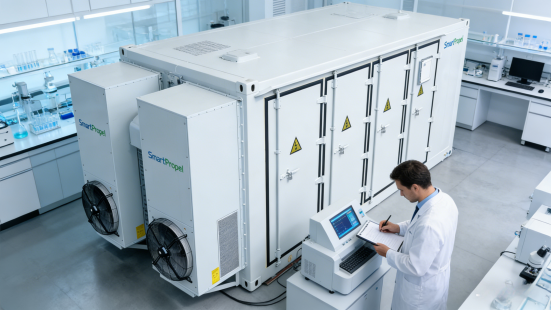
Product Iteration: 261kWh Liquid-Cooled All-In-One Cabinet Becomes Global Industry Standard
Combined with field research from the 2026 SNEC exhibition, the research report sorts out the full iteration roadmap of C&I energy storage products. The industry has bid farewell to customized, small-capacity early solutions; large-capacity, long-duration, fully integrated liquid-cooled all-in-one cabinets have become the universal unified choice.
Full industry shift to 314Ah large-capacity cells
Nearly all new 2026 industry products are equipped with 314Ah lithium iron phosphate cells, deriving the standard 261kWh integrated cabinet. Leading manufacturers simultaneously develop oversized 587Ah/588Ah cells to launch 418kWh and 522kWh large-capacity models for large industrial parks and high-energy-consumption data centers. CESA statistics show that among 188 new C&I storage products launched in 2025, 97 adopted 314Ah cells, holding an unrivaled market recognition rate.
Standardized 125kW/261.24kWh liquid-cooled all-in-one cabinet perfectly matches mainstream 90kW PV projects
In previous years, C&I storage featured chaotic specifications, high customization costs and long delivery cycles. From 2025 to 2026, the whole industry unified a standardized flagship solution: 125kW / 261.24kWh liquid-cooled all-in-one cabinet, covering 2–4 hours of energy storage duration. It precisely matches the average daily 247kWh power output of overseas small and medium 90kW distributed PV systems, achieving zero solar curtailment and no idle capacity waste.
The cabinet fully integrates PCS, BMS, EMS, closed liquid cooling circulation and aerogel fire protection systems without extra matching accessories required by clients. Its IP55 protection rating enables direct outdoor installation, eliminating civil engineering costs for dedicated storage rooms. Multiple cabinets can be connected in parallel for flexible capacity expansion, with full on-site deployment completed within a single day, drastically cutting project construction cycles.
Liquid cooling comprehensively replaces air cooling as mandatory selection trend
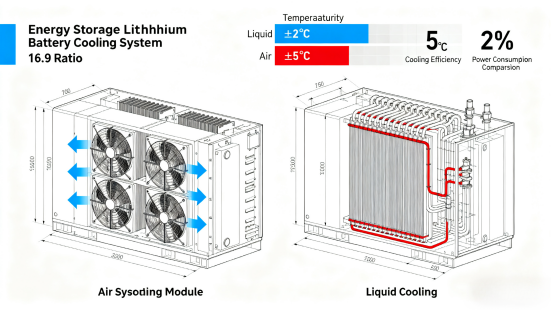
Independent test data from PV Magazine verifies this product iteration direction. Under European and German outdoor working conditions, air-cooled units carry an internal cell temperature difference of 8–10℃, with over 25% capacity degradation after 6,000 charge-discharge cycles. Annual maintenance expenses for filter and fan replacement reach €650. In contrast, the 261kWh liquid-cooled cabinet limits cell temperature difference to ±2℃, with annual maintenance costs below €120. It saves nearly €20,000 in hidden expenditures over a 10-year full lifecycle, fully matching overseas enterprises’ investment logic focused on long-term Total Cost of Ownership (TCO).
Far higher commercial value of C&I storage vs residential storage
Single residential storage units are priced at roughly 10,000–15,000 RMB, while the standardized 125kW/261kWh C&I liquid-cooled cabinet ranges from 200,000 to 300,000 RMB per set — over 10 times the unit price of residential products. It delivers higher battery self-matching ratio, stronger complete-machine added value, and far greater single-order revenue and profit elasticity compared to household storage equipment.
Four Core Reasons Why C&I Storage Growth Lags Behind Residential Storage
Many foreign trade practitioners question why residential storage has achieved mass overseas shipments while C&I demand remains delayed. The research report summarizes four fundamental objective factors that enterprises must address in advance when developing overseas markets:
Longer power price transmission cycle
Residential electricity prices fluctuate instantly with natural gas and energy costs, while industrial and commercial enterprises sign long-term power supply PPA contracts of 2–3 years. Rising electricity prices transmit to industrial clients 12–18 months later than households. Mass enterprise power supply contracts expired collectively from 2023 to 2024, pushing high electricity rates into full effect and unlocking real arbitrage value for C&I storage. Taking Germany as an example, intraday power price gaps rose from €70/MWh in 2022 to €160/MWh in 2026, significantly boosting returns from peak-valley arbitrage.
Cumbersome enterprise decision-making chains
Household residential storage purchase decisions take only 1–2 weeks. C&I storage involves high single-project investment, requiring joint IRR payback cycle calculations across finance, production and maintenance departments plus multi-layer internal approval. Project landing cycles generally stretch 6–12 months, leading to slower demand release rhythms.
Late maturity of standardized C&I storage products
Modular stacked residential storage products have been refined for years with unified specifications and simple installation. C&I storage only formed the unified 261kWh standard cabinet in 2026; highly customized designs in early years created long design, production and commissioning cycles, restricting mass shipments.
Higher barriers to channel construction
Residential storage can be distributed via mature dealers and home renovation channels. C&I energy storage requires dedicated project sales teams, solution engineers and local EPC partners, alongside grid connection commissioning and long-term after-sales maintenance support. Channel development starts from scratch with extended input cycles.
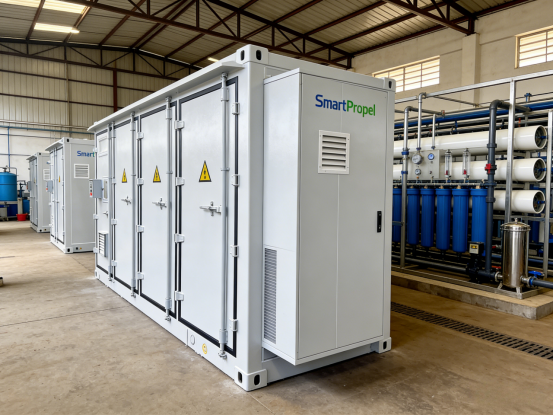
Four Underlying Global Drivers for C&I Storage Growth — Short-Term Oil Price Slumps Cannot Reverse Long-Term Prosperity
Recent market concerns that falling international oil prices will weaken demand for PV+storage diesel replacement. The research report refutes this view clearly: four core long-term drivers including policy support, economic returns, power supply rigid demand and energy independence remain stable, and short-term oil price volatility cannot reverse storage growth trends.
Global mandatory storage matching & subsidy policies (Policy Driver)
-
Southeast Asia: The Philippines mandates 20% storage matching for PV systems, while Thailand requires a 15% storage ratio. ASEAN countries rely heavily on Middle East crude oil imports, and energy security accelerates PV&storage popularization.
-
Europe: The Netherlands and Italy are phasing out net metering policies, sharply reducing pure PV revenue and forcing enterprises to deploy storage to lift self-consumption rates. The UK launched hundreds of billions of euros in subsidies, simplified grid connection for PV systems under 1MW, and requires 2-hour energy storage matching for newly built 5MW PV plants.
-
Oceania: Two rounds of storage subsidies totaling 7.2 billion AUD were rolled out. C&I storage deployment enjoys simultaneous equipment purchase discounts, driving doubled installation volume.
Widening peak-valley price gaps deliver stable 3–4 year project payback periods (Economic Driver)
Peak-valley power price gaps remain elevated across high-electricity-cost regions in Europe, Australia and North America, alongside falling hardware costs year over year. C&I storage generates overlapping returns from peak-valley arbitrage, demand charge management and PV self-consumption improvement. Standardized 261kWh cabinet projects generally recover full investment within 3–4 years, with over 10 years of pure profit cycles afterward, creating strong appeal for factory owners.
Rigid power backup demand in power-short regions of Asia, Africa & Latin America (Demand Driver)
Power infrastructure remains underdeveloped in Southeast Asia, Africa and Latin America with regular power outages. Traditional diesel generators deliver a power cost of $0.34–0.49/kWh, while PV&storage systems cut the cost to $0.098/kWh. Remote mining zones, factories and industrial parks are replacing diesel generators on a large scale. A gold mine in Peru deployed large-scale storage systems and saved $4.2 million in diesel expenditure annually.
Long-term macro trends of energy independence & carbon neutrality
National carbon neutrality targets drive mandatory renewable energy ratios for factories, commercial buildings and data centers. Self-owned energy storage becomes essential assets for enterprises to complete low-carbon indicators and avoid grid power rationing, creating persistent long-term demand.
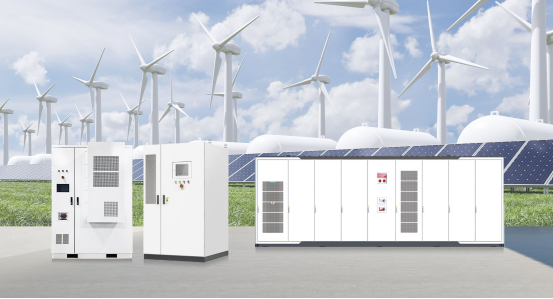
Five Major Industry Barriers for C&I Storage — Leading Manufacturers Gain Channel & Product Moats
The research report points out that entry barriers for C&I energy storage are far higher than residential storage, forming core moats for early overseas manufacturers and avoiding cutthroat low-price competition:
Complex grid connection certifications across different countries
Full sets of safety and grid connection certifications such as VDE, CE and IEC require 6–18 months with high certification costs, unaffordable for small niche manufacturers. Our 261kWh liquid-cooled cabinet natively supports Germany VDE 4105 / VDE 0108 standards with pre-completed full European certifications, directly breaking European grid connection thresholds.
High comprehensive technical thresholds
Systems must support multi-cabinet parallel operation, grid fault ride-through, intelligent EMS arbitrage scheduling, full-range high/low temperature thermal management, and liquid cooling thermal runaway fire protection — technical difficulties far exceeding small household batteries.
Heavy capital occupation for projects
Single 261kWh cabinet value is high, with overseas project advance payments only covering 10%–20% of total cost and capital occupation cycles of 6–12 months, imposing strict cash flow requirements on manufacturers.
High demand for customized solution capabilities
Load profiles vary drastically between factories, EV charging stations, mining zones and data centers. Professional return calculation and load matching solutions are required; pure hardware sales cannot retain long-term clients.
Long-term operation & maintenance service system requirements
C&I storage revenue relies on intelligent charge-discharge scheduling, requiring local technical teams for remote commissioning and regular on-site inspections. Manufacturers without overseas service networks face obvious after-sales weaknesses.
Manufacturers leveraging existing overseas residential storage dealer channels hold natural advantages: once channels are fully constructed, marginal costs for expanding C&I storage business remain extremely low, and channel reuse amplifies revenue and profit elasticity. This represents the optimal landing path for current export development: prioritize promotion of standardized 261kWh liquid-cooled all-in-one cabinets, enter small and medium off-grid factory projects in Southeast Asia first, accumulate grid connection and maintenance experience, then expand to large grid-connected industrial projects in Europe.
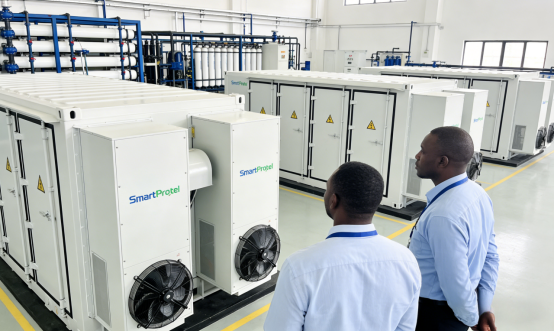
Optimal Standardized Global Solution: 125kW / 261.24kWh Liquid-Cooled All-In-One Cabinet
Combining market data from the research report, mainstream overseas 90kW PV configurations and strict European & German working condition requirements, our 261.24kWh liquid-cooled integrated energy storage cabinet serves as the optimal standardized product covering small and medium global C&I scenarios, fully matching all industry development trends:
Golden capacity matching
261.24kWh rated capacity aligns perfectly with the average daily 247kWh power generation of 90kW PV systems to realize zero solar curtailment and no idle capacity. The 125kW power rating simultaneously supports workshop production equipment
plus multiple on-site EV charging piles.
Long service life & ultra-low maintenance via liquid cooling
Automotive-grade closed circulation liquid cooling limits internal cell temperature difference to ±2℃, with less than 8% capacity degradation after 6,000 cycles. Total maintenance expenditure over 10 years only reaches €1,200, comprehensively outperforming air-cooled alternatives.
Pre-compliant for European market standards
The cabinet natively adapts to VDE grid connection protocols with full CE, IEC 62619 and EMC certifications, enabling direct grid connection for German and European projects without acceptance obstacles.
Minimal outdoor deployment requirements
IP55 dust and water protection with a -20℃ ~ +50℃ wide operating temperature range. Units can be placed directly on factory open ground without dedicated storage rooms, cutting civil engineering investment.
Fully integrated factory pre-commissioning
Pre-installed BMS / PCS / EMS / fire protection systems at the factory, with Modbus universal communication protocol to connect clients’ existing energy management systems. Multiple units can be paralleled for flexible capacity expansion to meet phased expansion demands of industrial parks.
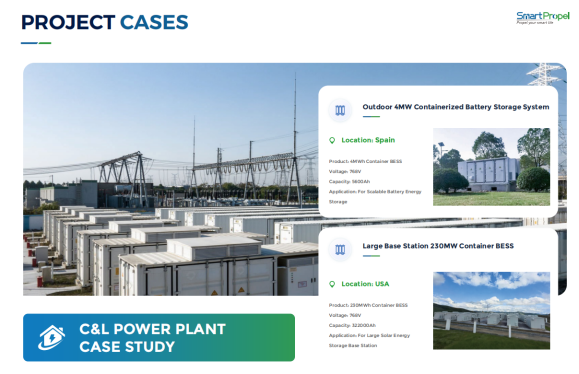
C&I Energy Storage — The Decisive Track for Energy Storage Export Competition
The core conclusion of the CITIC Construction Investment research report delivers powerful industry reference value: the residential storage market faces intensified stock competition at present, while C&I energy storage holds penetration below 1%, maintains over 60% growth in the next two years, and boasts a significantly larger long-term market scale. It represents a core track that all energy storage exporters must prioritize.
Global energy policies, high electricity prices and power shortage rigid demand continuously release three layers of growth dividends. The standardized 261kWh 314Ah liquid-cooled all-in-one energy storage cabinet has become a universal global product, suitable for PV supporting projects of small and medium factories across Europe, Southeast Asia and Australia.
For foreign trade sales staff, overseas EPC contractors and factory owners, abandoning short-term low-cost air-cooled equipment and selecting compliant, long-lifespan, low-maintenance standardized liquid-cooled storage solutions maximizes long-term investment returns of energy storage projects and seizes historic opportunities amid the C&I energy storage boom.