
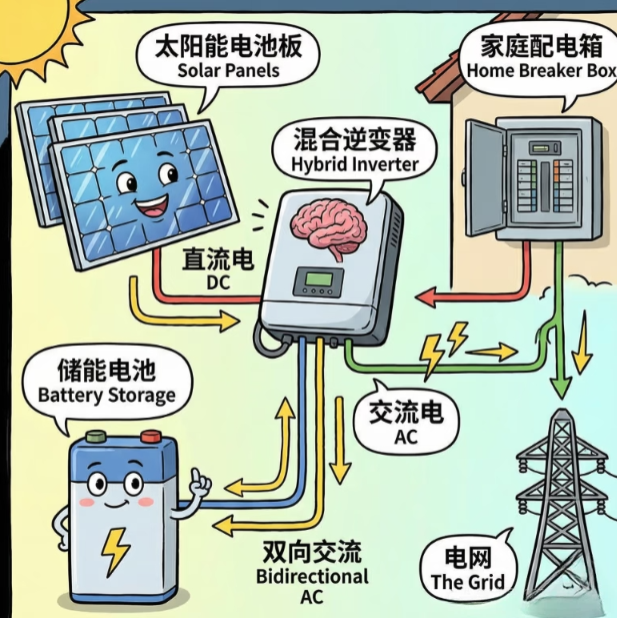
Residential lithium-ion energy storage systems have become a mainstream solution for household power cost reduction, blackout backup, and solar power self-consumption in 2026. Equipped with LiFePO4 battery packs, smart BMS (Battery Management System), and hybrid inverters, modern home energy storage systems effectively resolve unstable grid power, high peak electricity tariffs, and wasted photovoltaic power generation. Many household users face operational risks such as improper installation, unreasonable charging/discharging strategies, and shortened battery service life due to lack of professional guidance.
This guide summarizes standardized, user-friendly installation, daily operation, and maintenance processes from a professional technical perspective. It also provides a data-driven parameter comparison table to help users accurately configure, safely install, and efficiently use home energy storage systems, maximizing economic benefits and battery cycle life.
Core Composition & Functional Parameter Analysis
A complete home energy storage system mainly includes four core components: lithium battery pack, hybrid solar inverter, BMS, and household power distribution module. Different capacity configurations match diverse household power consumption scenarios. The following table lists mainstream 2026 household energy storage configurations, applicable scenarios, and core operational data, covering small, medium, and large household power demand.
| System Configuration | Rated Capacity | Continuous Output Power | Usable Energy (90% DOD) | Applicable Household Scenarios | Average Monthly Electricity Saving | Cycle Life (60% DOD) |
| Small Household System | 10.24kWh (51.2V 200Ah) | 3kW | 9.2kWh | Small families, basic lighting, refrigerators, low-power equipment | 120–180 kWh | 6500+ cycles |
| Medium Household System | 15.36kWh (51.2V 300Ah) | 5kW | 13.8kWh | Most ordinary families, match solar PV, daily full-house power supply | 200–280 kWh | 6000+ cycles |
| Large Household System | 20.48kWh (51.2V 400Ah) | 8kW | 18.4kWh | Large families, high-power electrical appliances, long-term off-grid backup | 300–420 kWh | 5800+ cycles |
Professional note: Adopting 60% DOD (Depth of Discharge) daily use mode can effectively extend battery life by 20%–30% compared with full charge and full discharge, which is the most cost-effective daily operation standard for household energy storage batteries.
Standard Professional Installation Process (Step-by-Step)
Home energy storage installation follows the principle of first assessment, second layout, third wiring, final debugging. The whole process is standardized and operable for users and installers, avoiding safety hazards caused by irregular construction.
Pre-Installation Assessment & Preparation
This is the core link to ensure system matching and safety. First, collect 3–12 months of household electricity bills to count average daily power consumption, peak and valley power gap, and confirm system capacity configuration. Second, select a standard installation location: dry, ventilated, away from heat sources and flammable materials, with ambient temperature controlled at 0–45℃, avoiding long-term direct sunlight. Finally, inspect household wall load-bearing and low-voltage circuit specifications to ensure matching with inverter output parameters.
Prepare complete accessories: lithium battery pack, hybrid inverter, special PV/ power transmission cables, grounding wire, circuit breaker, and BMS display module, and check all equipment for appearance damage and complete factory certificates.
Equipment Fixed Layout Installation
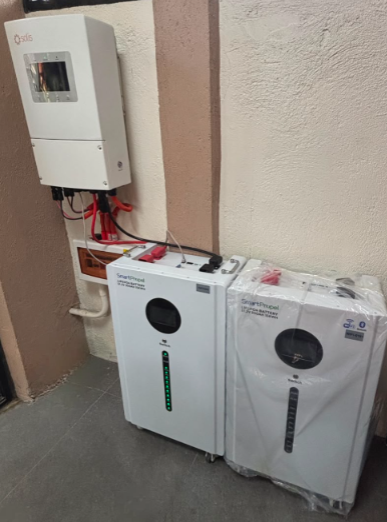
First, fix the battery rack firmly on the wall or ground to ensure horizontal placement and stable load-bearing, preventing battery deformation caused by long-term tilt. Place the lithium battery pack into the rack in order and lock the fixing bolts. Then install the hybrid inverter on the vertical wall close to the household distribution box, maintaining a distance of more than 30cm from the wall for heat dissipation, avoiding heat accumulation affecting operational efficiency.
Standard Wiring Construction
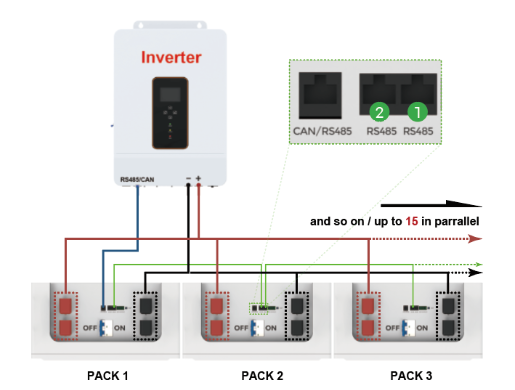
Follow the strict sequence of battery wiring first, then inverter wiring, finally grid load wiring. Connect the battery positive and negative poles to the inverter DC terminal with dedicated cables, strictly prohibiting reverse polarity connection. Install the BMS signal line to realize real-time monitoring of battery voltage, current, and temperature. Complete the AC wiring between the inverter and household distribution box, and configure a dedicated circuit breaker for overload protection. Finally, complete the system grounding operation, which is the key to preventing electric leakage and static damage.
System Debugging & Grid Connection Inspection
After wiring is completed, manually check all cable interfaces for firmness and insulation integrity. Turn on the system power supply, activate the BMS and inverter, set basic parameters including system voltage, charging/discharging power, and protection threshold. Conduct no-load test and load test in sequence: verify that the battery charging and discharging are normal, the inverter AC output is stable, and the BMS has no fault alarms. For grid-connected systems, complete power company filing and grid connection acceptance to realize formal grid-tied operation.
Professional Daily Use & Operation Strategy
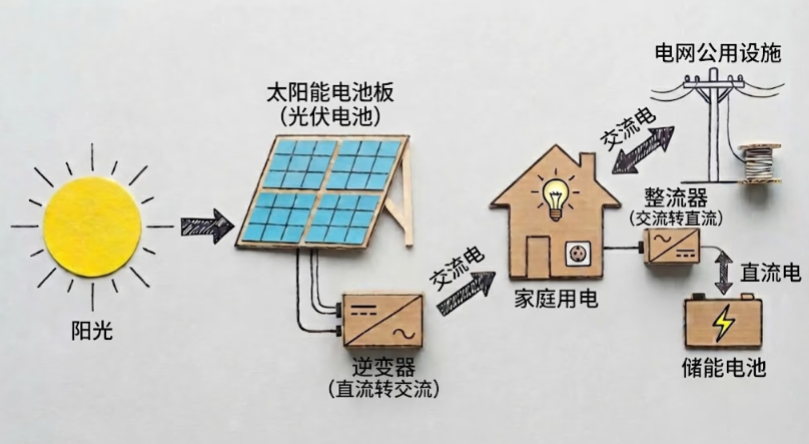
Scientific daily operation can maximize battery life and economic benefits. Combined with household peak-valley electricity price rules and battery characteristics, the following standardized use strategies are summarized.
Charging Strategy
Adopt valley price centralized charging + solar supplementary charging mode. Charge the battery during grid valley electricity price periods (00:00–08:00) to store low-cost electric energy. For PV-equipped systems, prioritize solar power charging during the day to reduce grid electricity consumption. Prohibit long-term full-charge floating charge; maintain the battery SOC (State of Charge) between 20%–90% in daily use, which is the optimal SOC interval for LiFePO4 batteries.
Discharging Strategy
Implement peak-period centralized discharging. Release stored battery power during household peak electricity consumption periods (18:00–22:00) to replace high-priced grid power and cut electricity costs. In case of grid power failure, switch to off-grid mode automatically to supply power for key loads such as lighting, refrigerators, and communication equipment. Avoid long-term deep discharge below 20% SOC, which will cause irreversible damage to battery cells.
Intelligent Monitoring Operation
Use the supporting BMS mobile APP or desktop monitoring system to view real-time battery SOC, temperature, voltage, and system power consumption data every day. Check abnormal alarms such as over-temperature, over-current, and unbalanced cell voltage in time. It is recommended to conduct a manual data calibration every two weeks to ensure accurate system operation data.
Daily Maintenance & Fault Prevention Guidelines
Routine Maintenance Cycle & Standards
Daily inspection: Check whether the equipment has abnormal noise, heat, or alarm prompts. Monthly maintenance: Clean the dust on the surface of batteries and inverters, check whether the cable interfaces are loose, and confirm the normal heat dissipation effect. Quarterly maintenance: View historical operation data, count charging and discharging cycles, and calibrate BMS parameters. Annual professional inspection: Invite professional technicians to conduct cell balance detection, line aging inspection, and system performance testing.
Common Faults & Solutions
First, low battery efficiency: mostly caused by long-term shallow charging and discharging or unbalanced cell voltage, which can be solved by regular full charge and discharge calibration. Second, system overheating alarm: check whether the heat dissipation channel is blocked or the ambient temperature is too high, and clean dust and optimize ventilation in time. Third, charging failure: confirm whether the grid voltage is stable and whether the cable interface is loose, eliminate line faults, and restart the system for recovery.
Key Safety Operation Specifications
-
Prohibit private disassembly and modification of batteries and inverters to avoid damage to BMS protection functions and safety accidents.
-
The system operating ambient temperature is strictly controlled within 0–45℃; stop charging and discharging in extreme high and low temperature environments.
-
Avoid water soaking and strong vibration of energy storage equipment, and keep the installation environment dry and clean.
-
In case of system failure and alarm, cut off the power supply in time and contact professional after-sales personnel for maintenance, do not operate blindly.
The safe installation and efficient operation of home energy storage systems depend on standardized construction processes and scientific use strategies. For household users, selecting a matched system configuration according to their own power consumption characteristics, strictly following professional installation steps, and adopting peak-valley optimized charging and discharging modes can not only ensure the safe and stable operation of the system but also maximize battery cycle life and electricity cost savings. With the continuous popularization of residential distributed energy, standardized use and maintenance of home energy storage will become the core foundation for long-term stable operation of household new energy systems.