
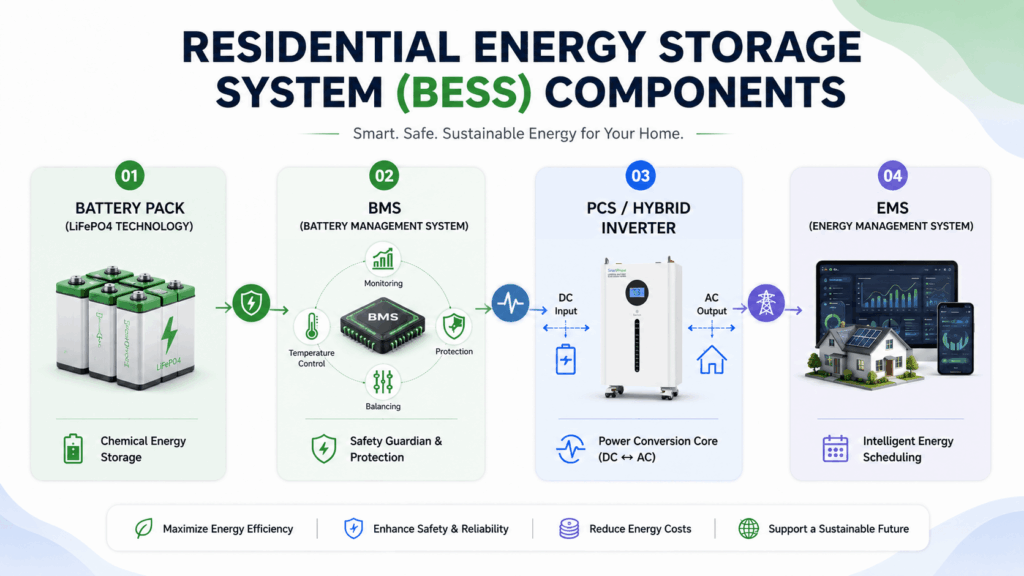
What’s inside a home battery storage system? We explain every residential BESS component — LiFePO4 battery pack, BMS, hybrid inverter (PCS), EMS and more — and how they work together to keep your home powered and cut your electricity bill.
A home battery backup is far more than a big battery bolted to a garage wall. In practice, it is a tightly integrated network of hardware and software that captures, converts, stores and redistributes electricity — often within milliseconds. A well-designed residential battery energy storage system (BESS) does three jobs at the same time: it keeps your lights on when the grid goes down, it maximizes the value of your rooftop solar, and it shaves the expensive peak-time electricity off your utility bill.
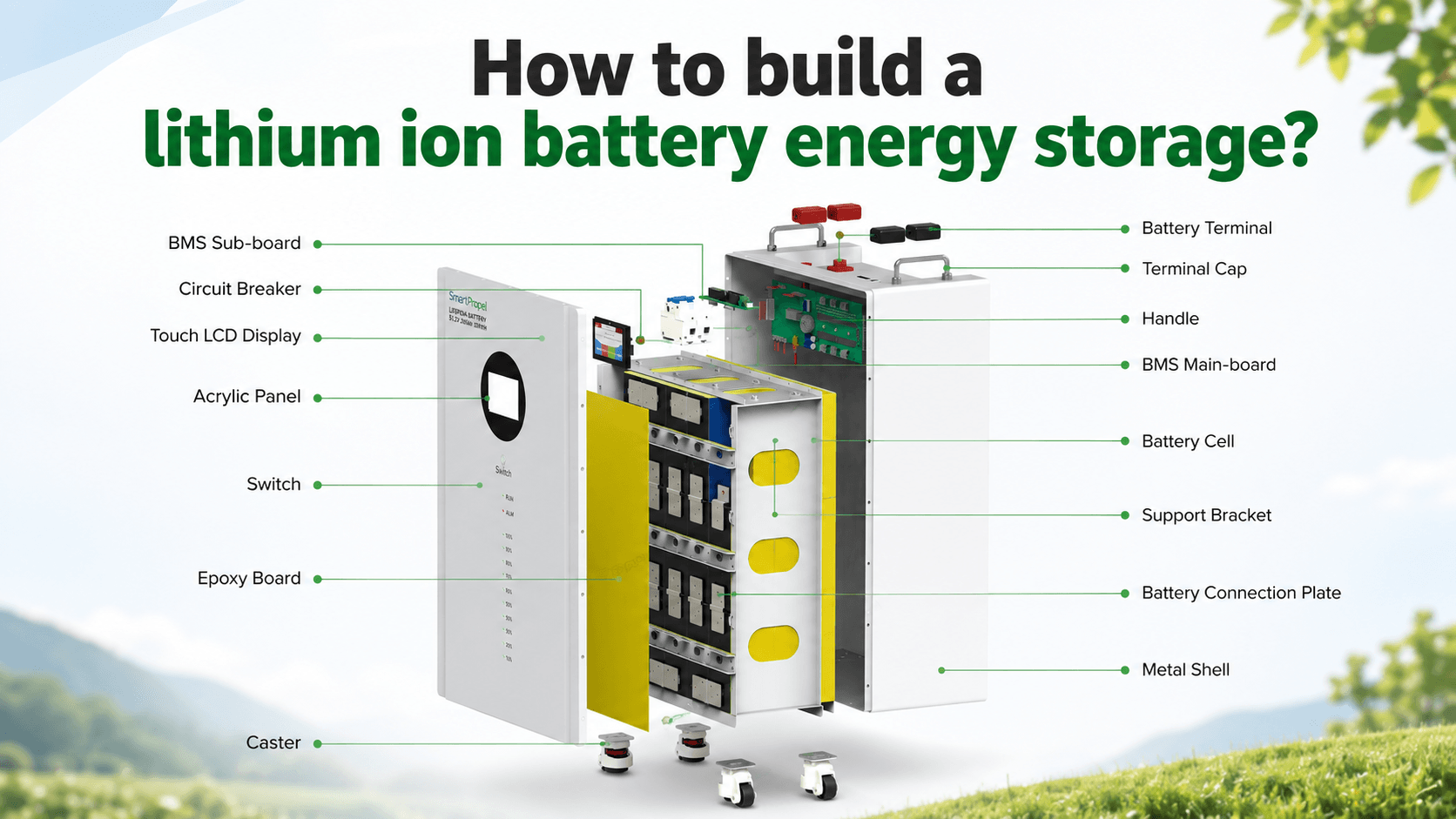
Understanding what is actually inside the box — and how every component talks to the others — is the first step to choosing a system that will still be running reliably a decade from now. In this guide we break down every core component of a modern home energy storage system, from the LiFePO4 battery pack at its heart to the smart software that decides when to charge and when to discharge.
The Core Components of a BESS at a Glance
| Component | Its role in the system |
| Battery pack (LiFePO4) | Stores the electrical energy; defines capacity, cycle life and safety |
| Battery Management System (BMS) | Monitors every cell, prevents overcharge / over-discharge, balances cells |
| PCS / Hybrid Inverter | Converts DC ↔ AC between the battery, solar and your home |
| Energy Management System (EMS) | Optimizes when to charge and discharge to save money |
| MPPT Charge Controller | Maximizes solar harvest in DC-coupled systems |
| Enclosure & Thermal Management | Protects the hardware and keeps cells in a safe temperature window |
Battery Pack: The Energy-Storage Heart
The battery pack is the chemical heart of the system. It defines how much energy you can store (kWh), how many times the system can cycle before degrading, and — most importantly for a home product — how safe it is.
Modern residential systems overwhelmingly use lithium iron phosphate (LiFePO4) cells, and for good reason. LiFePO4 chemistry offers near-zero risk of thermal runaway, outstanding thermal stability, and a very long cycle life that degrades very slowly even after thousands of charge–discharge cycles. That is why SmartPropel builds all of its home and commercial storage products — from the floor standing battery to the stackable home battery and rack-mounted energy storage battery — on Grade-A LiFePO4 cells.
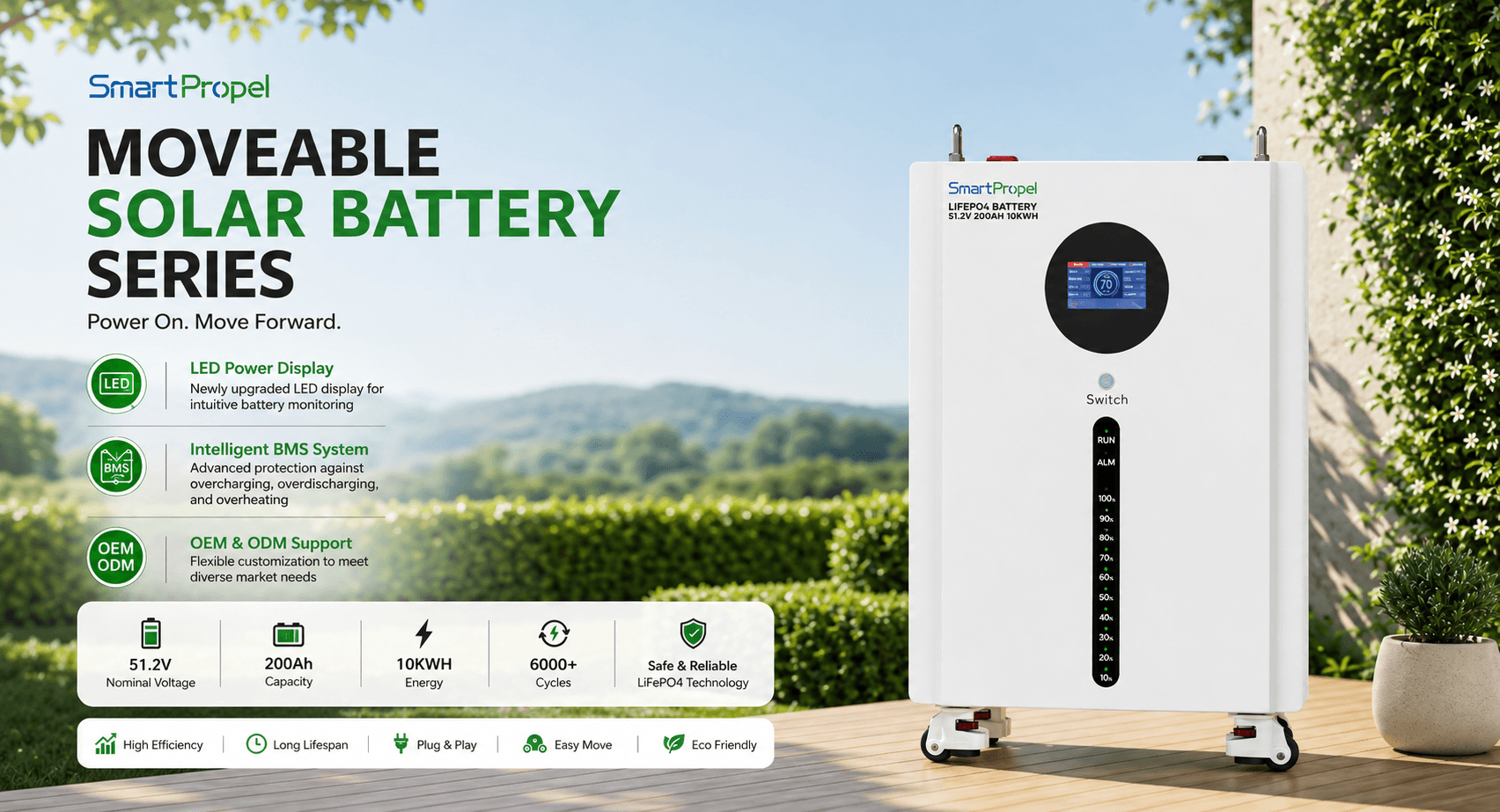
Key specs to look for: total capacity (kWh), usable capacity (after the Depth of Discharge limit), rated power (kW), and cycle life at 80% remaining capacity. Premium LiFePO4 packs typically deliver 6,000+ cycles; operating temperature range varies by model (often around -20°C to 60°C), so always check the specific datasheet.
Battery Management System (BMS): The Safety Guardian
A dense LiFePO4 pack needs precise, round-the-clock supervision — that is the job of the Battery Management System (BMS), an electronic core integrated directly inside the pack. It continuously measures each cell’s voltage, current and internal temperature, acting as the first line of defense against hazard.
If it detects an abnormal condition — overcharge, deep discharge, overcurrent or extreme temperature — the BMS cuts the circuit immediately to protect both the battery and your home. Beyond protection, cell balancing is the BMS’s most valuable long-term function. Because cells naturally charge at slightly different rates, small gaps appear over time; active balancing continuously redistributes energy across cells to maximize usable capacity and extend system life.
SmartPropel’s Powerwall and Stackable batteries integrate a built-in Smart BMS with an LCD panel for checking cell voltage, temperature, capacity and cycle count at any time, and support RS485 / RS232 / CAN communication for seamless integration with most inverters. For a deeper look at how a management system protects a battery, see our guide on BMS and energy-storage safety design.
PCS / Hybrid Inverter: The Power-Conversion Core
The battery stores energy as DC, but your home and the utility grid run on AC. The power conversion system (PCS) — usually called a hybrid inverter in residential systems — sits at the center, connecting three sides: DC solar input, AC grid input and AC home output.
Two capabilities separate a good residential hybrid inverter from a basic one:
-
High conversion efficiency — top modern inverters reach around 98% peak efficiency, minimizing wasted energy at every charge and discharge.
-
Islanding / anti-islanding — in a grid outage, the inverter safely disconnects the home from the grid in real time so your solar panels can keep charging the battery and your home keeps running.
-
Communication compatibility is one of the most common pain points in real installations. A mature storage supplier validates its batteries against the inverters you actually use. SmartPropel’s engineering team provides pairing guidance for major global inverter brands (SMA, SolarEdge, Growatt and many more) — see our inverter power matching guide for 10 kWh and 16 kWh storage batteries.
Energy Management System (EMS): The Smart Brain
Where the BMS protects the hardware, the Energy Management System (EMS) optimizes the economics. The EMS is the software-driven brain that watches real-time household consumption, local weather and your utility’s time-of-use (TOU) tariffs.
Based on that data, it executes a dynamic dispatch strategy: store surplus solar during peak irradiance, discharge during expensive peak hours, and draw from the grid only in cheap off-peak windows. Homeowners can set their own priority — maximum savings, maximum backup reserve, or a low-carbon mode. The result: in regions with high or time-varying electricity prices, an intelligent EMS can cut a household’s electricity bill dramatically while the system runs automatically.
In most residential setups, the EMS and its control app are delivered together with the hybrid inverter or the system platform — so when you buy a battery separately, confirm which EMS / control app is bundled or supported.
Supporting Hardware: MPPT Controller & Thermal Management
A complete BESS also depends on auxiliary hardware that solves real-world installation issues.
MPPT charge controller. In DC-coupled architectures, solar panel output fluctuates constantly with sun angle and cloud cover. A maximum power point tracking (MPPT) controller adjusts voltage and current in real time to match the battery’s charging window, capturing far more solar energy than a fixed-parameter controller. In cloudy or variable climates this alone can recover several percent of annual solar yield.
Enclosure & thermal management. Batteries are a long-term home investment and need solid physical protection. An IP65-rated enclosure keeps out dust, moisture and pests, indoor or outdoor. Because temperature extremes accelerate aging, a professional system combines passive aluminum heatsinks with active low-noise cooling, and can add a low-temperature heating module for alpine climates.
AC-Coupled vs DC-Coupled Architecture
How the components are wired determines overall efficiency and how easy the system is to install:
| DC-coupled | AC-coupled | |
| Structure | One shared hybrid inverter for solar + battery | Two separate inverters (solar & battery) |
| Efficiency | Higher (no double conversion) | Slightly lower (DC→AC→DC) |
| Best for | New off-grid / grid-tied solar installs | Retrofitting an existing solar system |
| Wiring effort | More re-layout at install | No need to rewire existing panels |
As a rule of thumb: DC coupling wins for new builds and maximum efficiency; AC coupling wins for adding storage to an existing solar array without re-wiring. Many modern systems support both architectures.
Key Specifications to Evaluate Before You Buy
Capacity (kWh) vs usable capacity. Total capacity is the headline number, but the Depth of Discharge (DoD) determines what you can actually use. A 10 kWh battery at 90% DoD gives you about 9 kWh of usable energy.
Power rating (kW). This decides whether the battery can start and run high-draw appliances like central air conditioning or an EV charger simultaneously.
Cycle life. Residential products commonly rate 3,500–4,500 cycles; high-end LiFePO4 systems reach 6,000+ cycles, roughly 10–15 years of daily use.
Scalability. Can you add more modules later?
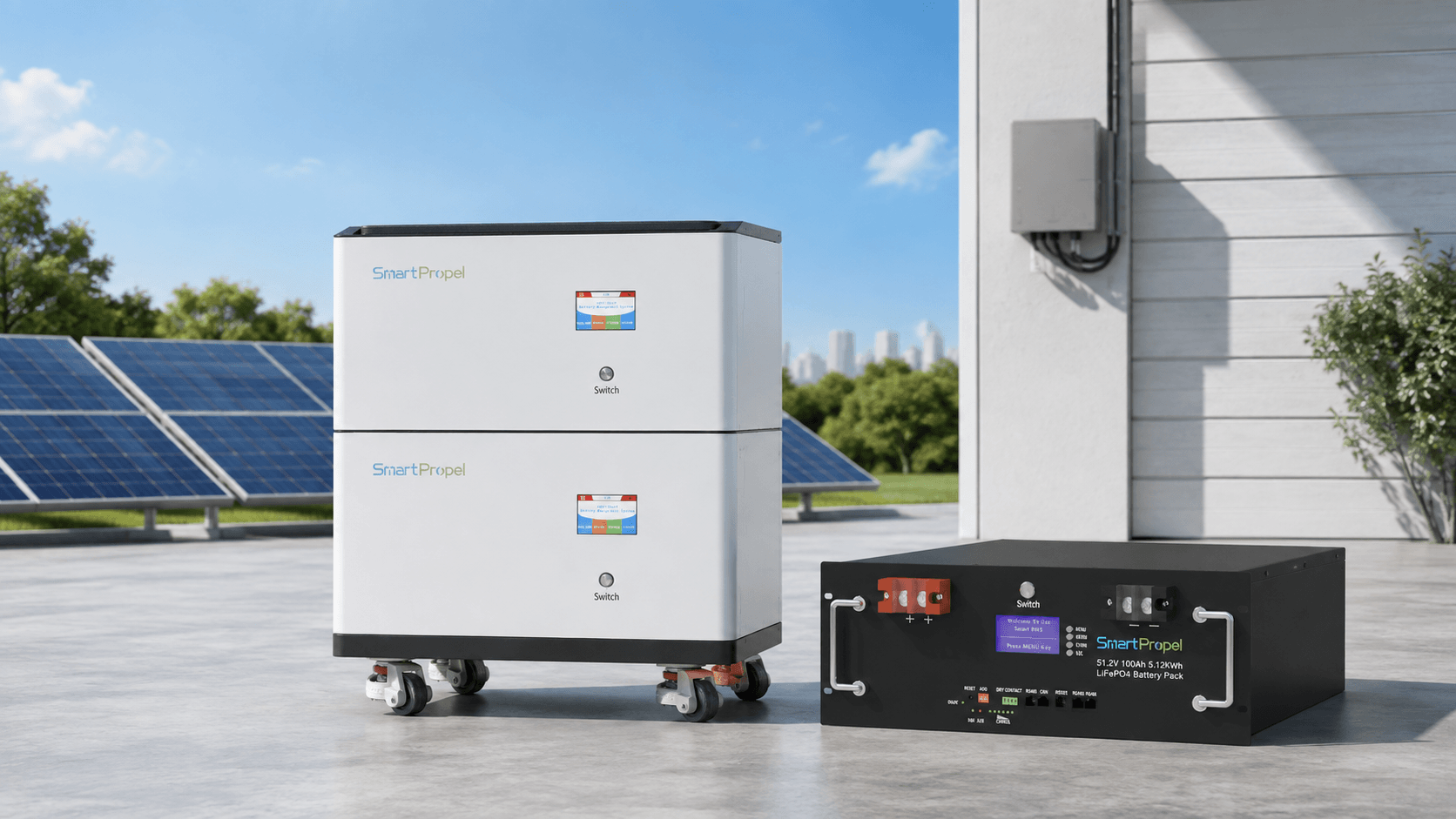
SmartPropel’s stackable battery grows from 10 kWh to 50 kWh per stack, and its rack-mounted battery connects up to 15 modules for systems from 5 kWh to 300 kWh — useful if your home’s load grows over time.
Safety and Certification: The Non-Negotiable Checklist
For any battery that will live inside (or right next to) a home, safety certification is non-negotiable. When you evaluate a system, confirm it carries the relevant standards for your market:
-
UN38.3 — mandatory transport safety testing for lithium batteries by air, sea and road.
-
IEC 62619 — safety requirements for stationary lithium-ion batteries, widely expected by EU / CE compliance pathways and global commercial buyers.
-
UL 1973 — the de-facto safety benchmark for stationary battery systems in North America.
-
CE / RoHS / MSDS — required for selling into the EU and many other markets.
-
SmartPropel’s products are tested to UN38.3, CE, RoHS and MSDS, and its LiFePO4 power series is validated to IEC 62619 and UL 1973 safety standards. If you’re choosing between systems, certification documents are not paperwork — they are the single fastest way to separate engineering-grade products from cheap imports.
Q1. Is LiFePO4 the best battery chemistry for home storage?
Yes for most homes. LiFePO4 offers the best balance of safety (near-zero thermal runaway risk), long cycle life and cost over 10+ years, and it complies with UL 1973 / IEC 62619. That is why it dominates new residential installations.
FAQ
Q2. How long will a residential BESS last?
Industry-average systems last about 7–10 years. Higher-end LiFePO4 systems with active-balancing BMS and smart thermal management typically run 12–15 years.
Q3. Can home batteries run in extreme temperatures?
Entry-level systems can throttle or stop above ~50°C or below -10°C. Premium systems operate around -20°C to 60°C, with optional low-temperature heating for cold climates.
Q4. How much can I save with a home battery?
Savings depend on your local TOU tariff and usage. In high-price regions, smart EMS scheduling can cut household electricity bills substantially, with typical payback around 5–6 years.
Q5. Do I need solar panels to use a battery?
No. Without solar, a battery can still charge from the grid at cheap off-peak rates and discharge at peak times (arbitrage), plus provide backup during outages.
A residential battery energy storage system is not a single product — it is an ecosystem: a LiFePO4 battery pack, a protective BMS, a high-efficiency hybrid inverter (PCS), an intelligent EMS, and supporting hardware that keeps everything safe and cool. The best systems don’t just have great components; they are engineered so those components work together, meet international safety standards, and can grow with your home’s energy needs.